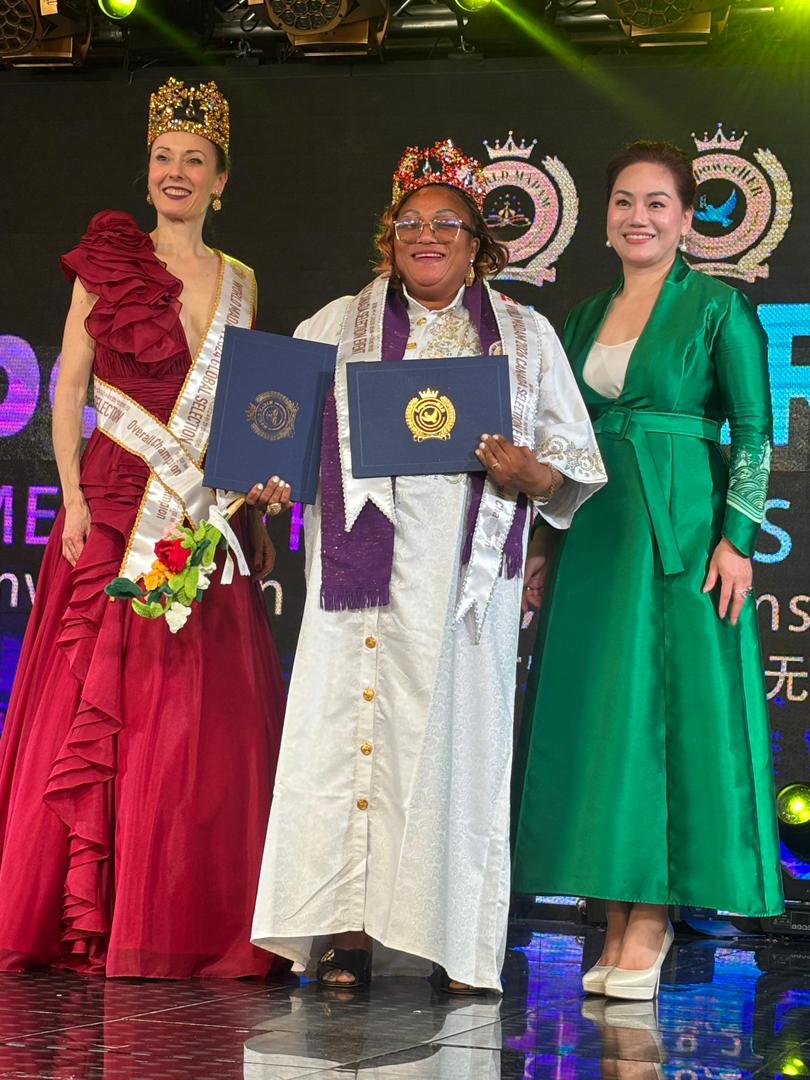
Prof Elizabeth Pedro middle displaying the two awards won at the UN
Francis Odupute
On Wednesday, the 18th of March, 2026, from the global stage in New York to a prestigious International Women’s Day celebration in Africa, Professor Elizabeth Pedro, the founder and global leader of Women Helping Women (WHW) Foundation, was honored with three major awards in a single day.
At the UN CSW70 Side Event, Professor Elizabeth Pedro received two elite awards presented by the WORLD MADAM Foundation and the EmpowerHer Forum, namely: The Women’s Philanthropic Excellence Award: A prestigious recognition for her significant contributions to charity and her lifelong dedication to improving the welfare of women and girls child globally.
Second was the “Overall Champion: WORLD MADAM 2026 (Canada Annual Selection)”, a title that recognizes Prof. Pedro as a global gold standard for womanhood, leadership, and empowerment.
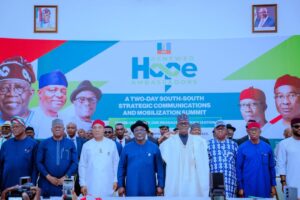
While the philanthropist was receiving these two awards in New York at the UN CSW70 Side Event, simultaneously, back home in Benin City, her humanitarian impact was celebrated at a high-level International Women’s Day event organized by the Hapiwify Project in collaboration with the Conference of No-governmental Organizations (CONGOs), Edo State.
The award was christened “A Certification Award for Outstanding Contributions to Women’s Empowerment”. In the evolving landscape of women’s empowerment, where advocacy is often loud but impact sometimes shallow, Apostle Professor Elizabeth Pedro stands out for a different reason: her insistence that transformation must be both spiritual and structural.As the visionary behind Women Helping Women (WHW) and its international expression, Women Helping Women International (WHWI), Professor Pedro has built more than an organization.
She has cultivated a movement rooted in faith, leadership development, and practical empowerment—one that is increasingly attracting attention across continents.
The story of Women Helping Women is not simply inspirational; it is strategic, scalable, and impact-driven. Talk about a calling that became a global mission!
Apostle Professor Pedro traces her journey back to a deeply personal conviction: that every woman carries what she describes as “divine potential.” Her life-long slogan, “empower a woman, empower a nation’ continues to re-echo in her various humanitarian interventions.
Growing up, Prof. Elizabeth Pedro encountered women whose gifts were buried under cultural expectations, economic hardship, and societal limitations.
Their stories became her catalyst. “Empowerment,” she has often said, “is not a privilege—it is a necessity.”
That conviction evolved into structured intervention. Today, through WHW and its allied platforms, she leads programs that restore confidence, provide vocational skills, mentor emerging leaders, and build systems designed to sustain long-term change rather than temporary relief.
Her leadership portfolio is expansive—doctor, ambassador, founder, coach—but she describes each title as an extension of one mission: to serve humanity through faith, empowerment, and compassion.
Unlike many development initiatives that treat spirituality as peripheral, Professor Pedro places faith at the center of her leadership philosophy.
She openly describes herself as “God’s Own,” a declaration that shapes both her decision-making and institutional culture.
For her, faith is the framework, not an ornament. Through Great Shepherd Ministries, she integrates spiritual guidance with community outreach, addressing not only economic and social needs but also what she calls “the soul’s need for hope.”
This integration of faith and empowerment has proven particularly resonant in under-served communities, where spiritual institutions often serve as trusted pillars of society.
For sponsors, this presents a unique advantage: programs embedded within values-based networks often enjoy higher community acceptance and deeper long-term engagement.
Beyond grassroots work, Professor Pedro’s global engagement reflects a broader philosophy of inclusive leadership.
As an Ambassador of Peace to the United Nations—a role she describes as requiring empathy, collaboration, and moral courage—she advocates for peace that begins within individuals and expands outward to families, communities, and nations
.Her peace-building approach aligns seamlessly with the mission of Women Helping Women. Economic insecurity, gender inequality, and social marginalization often fuel instability.
By equipping women with skills, confidence, and leadership capacity, WHW contributes to preventative peace-building at the community level.
For international development partners, this linkage between empowerment and stability represents measurable social value.
When asked how she defines success, Professor Pedro’s response is telling: transformation over numbers. She believes in measuring success in transformation, not applause.Success, in her framework, is visible when a once-doubtful woman becomes a mentor to others.
It is measured in generational impact rather than event attendance or media coverage.This philosophy shapes WHW’s programming model.
Initiatives are designed not merely to train participants but to position them as multipliers—women who will, in turn, uplift others.
The organization’s vocational hubs, mentorship platforms, and leadership training initiatives reflect a long-term sustainability mindset.
Rather than short-lived interventions, they aim to build economic independence, personal confidence, and community influence.One of the most distinctive aspects of Professor Pedro’s leadership is her understanding of communication as a strategic asset. She employs strategic communication as a tool for expansion.
She emphasizes empathy-driven messaging—beginning with understanding audience realities before crafting narratives. Storytelling, she notes, inspires where statistics alone cannot. By sharing authentic accounts of women who have overcome adversity, the organization bridges cultural divides and galvanizes global support.Beyond program implementation, Professor Pedro invests heavily in mentoring emerging leaders.
Her training emphasizes clarity, compassion, and confidence in public engagement. Leaders, she teaches, must speak from conviction rather than convenience.
This leadership pipeline ensures continuity and scalability—two factors critical to long-term institutional sustainability.Her envisioned legacy is not one of titles, but of courage, character, and compassion.
She hopes future female leaders will understand that greatness is defined not by position, but by impact.
This emphasis on leadership replication signals return on social investment: empowered individuals who evolve into community change agents.