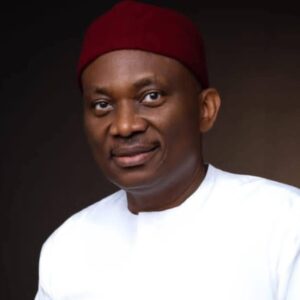

Gov Monday Okpebholo
By Kingsley Abavo in Benin
On Tuesday, 16 December, 2025, Edo State governor, Senator Monday Okpebholo presented to the State House of Assembly, the 2026 Appropriation bill christened ‘Budget of Hope and Growth.’
[the_ad id=”16914″]
The budget proposal of N393.85b showcases an ambitious fiscal roadmap target at consolidating the gains of his first year in office, and restoring public confidence in governance.
The budget plan has been designed to consolidate on the foundation laid in 2025 while expanding the reach of government programmes to directly impact the lives of Edo people, across all sectors of the economy, Okpebholo said.
While placing priority on key areas critical to sustainable development, including; security, infrastructure, agriculture, education, job creation and healthcare.
As he asserts that the focus of his administration remains on delivering “development the people can see and feel.”
Budget breakdown
The budget breakdown indicates; capital expenditure at ₦637 billion, representing 68 per cent of the total sum, while recurrent expenditure is pegged at ₦302b, accounting for 32 percent.
[the_ad id=”16917″]
The heavy prioritisation of capital expenditure in the 2026 budget plan, was due to the resolve of the All Progressives Congress (APC) government to accelerate development through investments in social infrastructure, and other economically impactful projects across the State, the Governor explained.
In working to actualise the budget target, Edo residents would not be scapegoated with unnecessary financial burdens he assured.
Instead, efforts would be intensified to strengthen revenue systems, block leakages and improve public finance management, Okpebholo added.
Sectoral allocation
The economic sector received the largest share with ₦614.2b earmarked for agriculture, roads, transport, urban development and energy, with priority given to rural and urban road construction, completion of two flyovers, drainage works, urban renewal and expansion of farm estates and irrigation facilities.
The social sector was allocated ₦148.9 billion to cater for education, healthcare, youth development, women affairs and social welfare, including plans for extensive school renovations, recruitment and training of teachers, expansion of healthcare facilities and investments in youth skills, sports and entrepreneurship programmes.
For governance and service delivery, the administration sector was allocated ₦157.7 billion to drive civil service reforms, training and deployment of digital tools, improved revenue collection systems, support for ministries, departments and agencies, and the rollout of e-governance platforms.
While the justice sector received ₦19 billion to strengthen courts, enhance justice delivery, and support legal reforms and access-to-justice programmes.
As regional development and local government support will focus on grassroots empowerment, community roads, rural electrification, water and sanitation projects, and security outposts in border communities.
Further, Okpebholo asserts that the budget is anchored on his SHINE Agenda, built around five pillars of Security, Health, Infrastructure, Natural Resources/Agriculture and Education, with the vision of creating a prosperous, united Edo State where every citizen feels the impact of governance.
Funding
The 2026 budget is intended to be funded through the Internally Generated Revenue (IGR) projected at ₦160 billion, Federation Account Allocation Committee (FAAC) inflows estimated at ₦480 billion, capital receipts and grants of ₦153 billion, as well as ₦146 billion expected from Public-Private Partnerships and other revenue windows.
In the journey so far; the Governor expressed gratitude to the President, Bola Ahmed Tinubu for national reforms which he said have bolstered revenue flows to States.
Also, he commended the Speaker and members of the State Legislature for their cooperation, and appreciated traditional rulers, faith leaders, political appointees and civil servants for their support i