
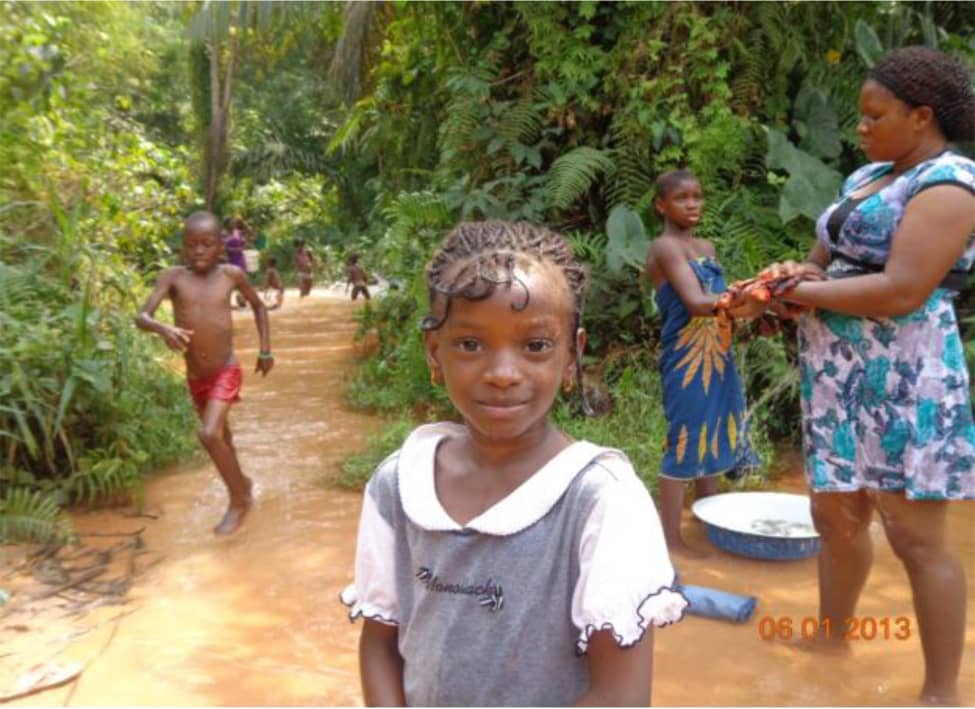
Fetching water at the Ekpe EbileOgu River, children also have fun there
With pictorial splash of lack of social amenities, obvious fiscal allocation abandonment, ecological and environmental crises, criminal negligence of community development; Inhabitants of oil rich Niger Delta community struggle for survival.
By Francis Umendu Odupute
Onyeka was totally frustrated and confused. She never bargained for what she was now facing: a New Year of stress and ‘slave labour’ for water.
[the_ad id=”16914″]
The fateful day was Sunday morning, January 6, 2013. The last straw that would break the camel’s back had just landed on the mother of four, as she made yet another frantic phone call to remind the water tanker dealer who was to drive down to Ubaha village in Eziawa from a neighbouring community, to supply her with half a tanker load of water for a whooping N10, 000.
Two days running, all efforts by the young mother to persuade the water dealer to as a matter of urgency drive down to Eziawa to supply the water, as agreed, cut no ice as the man gave various excuses over the phone as to why he could not make it any longer to Eziawa.
First, he had more people pestering him from other communities with better roads networks and easier environmental terrain demanding to be supplied with water that same period than he could handle.
Second reason: the water tanker man claimed his vehicle would get stuck on the way because Eziawa roads are no-go area for most vehicular movement of people and farm products, let alone a loaded water tanker. He didn’t want his business to be hindered because of one customer who lives in “the road to hell” needing water badly.

Further phone calls by Onyeka and the fellow wouldn’t even pick his call anymore. The Diaspora lady who was briefly home for Christmas with her kids, got the full message: the chips are down! She just had to prepare her mind for the long trek to Ekpe EbileOgu River, to wash all the piles of clothes her kids had messed up, plus fetch drinking water for cooking and drinking. Something she could never dream of in Cameroun.
[the_ad id=”16918″]
That was to be the grave consequence of being a bit too generous in giving out free water to neighbours who always frequented their home to request for the water that her husband and mother-in-law had carefully preserved for months in their large GP septic tank and other water containers stored up in the house ahead of the much planned home coming to Nigeria with her four kids for the 2012/2013 Christmas/New Year holidays. She had forgotten that in Eziawa, water is simply gold.
Onyeka and her family live in neighbouring Cameroun. She left Nigeria with her husband, Kendo, seven years earlier when their first child, Obinna, was barely five months old. Over the years the woman had refused to visit home for many reasons. Understanding the degree of hardship, poverty and lack of access to social amenities in his hometown of Eziawa, Onyeka’s hubby had travelled down to Nigeria three months ahead to make the house a home for his family when they eventually arrived Eziawa. One of such things her husband made a priority was to ensure there was more than enough water in the house for his family to use throughout their one-month stay in the village. Besides, he made adequate provisions for the medical needs of the children and also gave them sufficient money to take care of feeding and any exigencies.
Alas! Few days after the water crisis began to take its dire tolls on the polygamous home, everybody started escaping back to the cities and the mother of four had to contend daily with traveling some kilometers, climbing and descending small hills and landslides with her kids to wash clothes or fetch water from the river in order to survive. Alas! Joining the bandwagon of holiday makers now escaping from the biting water scarcity in the small rural community, Onyeka wasted no time in sending a S.O.S message to Cameroun soon enough for the man of the house to recall his family back to base posthaste.

Welcome to Eziawa autonomous community, the administrative headquarters of Orsu Central Development Area…somewhere in Nigeria’s oil-rich Niger Delta.
Ours is one town with many tales. Popular for its hilly terrain, perennial ecological crises, erosion devastations, acute water scarcity, political and educational disadvantages/handicaps, extreme poverty, poor access roads leading in to or out of the community or for transporting farm products and goods in and out, irregular and erratic power supply, flood ravaged environment, lack of social amenities, very poor educational and health facilities, low standard of living and zero access to clean water, … name it!
[the_ad id=”16917″]
This minority community in Orsu Local Government Area of Imo State, Nigeria, however, has one thing going for them for a possible global award and that is: suffering and smiling, resiliently hoping against hope.

In an article entitled *“Eziawa: The Road To Hell”,* published by the ORSU HEARTLAND MAGAZINE in 2003, this is how the writer comically and graphically painted the picture of Eziawa and the state of roads in this highly blessed community thriving in palm trees, palm oil, palm wine and all palm product businesses:
[the_ad id=”16920″]
“The roads in Eziawa are in deplorable condition. All of them look like abandoned project. What a disgrace to intra-neighbouring communities. Our roads have become death traps, because of numerous potholes and landslides. The central road to the only decked bridge, connecting the town to Ihitenansa already is cut off by erosion. Gully erosion is seriously claiming our major roads. Both the major and minor roads in the community are a thing of remember and regret. Riding of cars is now a nightmare… I remember when Eziawa roads used to be superlative…

“Today the story is different…Yet our people do not bother; the government of the day is not making any effort to save the people of Eziawa from this disaster. Transporters and visitors dread coming to Eziawa because of the nature of the roads.

“How can we take measures and tackle the challenges of this ugly situation? Our community administration is almost in exile; our traditional ruling class is busy in the palace with their flambouyant display of clothes…

”This is the school where this reporter obtained part of his elementary/primary school education. Over 40 years on, the building, now with leaking roof, has remained strong, albeit not properly maintained by the authorities concerned.


Hon. C.E. Okafor, the acclaimed contributor of the above article published in the second edition of Eziawa Heartland Magazine in December, 2004, however, offered some suggestions, which this report shall examine later on.
(To be continued)